
 1 hour ago
1
1 hour ago
1
Macro investor Jordi Visser is arguing that Bitcoin’s original purpose is coming back into focus as the Federal Reserve faces a new macro trap shaped by debt, oil, slowing growth and weakening employment. In a note published March 30 under the banner “D.O.G.E. 2.0,” Visser says that mix could leave policymakers unable to impose the kind of economic pain a traditional inflation fight would require.
His framework repurposes the acronym into four pressures: debt as the structural constraint, oil as the inflation shock, growth as the casualty of tighter conditions, and employment as the side of the Fed’s mandate that may soon take precedence. The broader claim is not simply that inflation could return, but that it could return in a form monetary policy cannot easily fix.
Why Bitcoin Could Be The Big Winner
Visser’s argument starts with supply-side stress. He points to oil prices rising after the war with Iran disrupted flows through the Strait of Hormuz, while import-price pressures and higher memory-chip costs linked to AI demand were already feeding through global supply chains. “That is what makes this moment dangerous,” he writes. “The inflation problem may be returning, but it is returning for reasons the Fed cannot easily solve, all while affordability remains a major political issue. Rate hikes do not reopen Hormuz. They do not create more DRAM.”
From there, he shifts to what he sees as the crucial difference between today and the 1970s. Back then, Visser notes, federal debt stood near 35.5% of GDP in 1970 and around 31.6% by 1979. Today, he says, the comparable figure is about 122.5%. That changes the amount of pain the system can absorb. In his telling, the United States is confronting the possibility of a second inflation wave with a debt burden roughly four times heavier than at the end of the last major oil-driven inflation era.
He makes the same point through asset valuations. The stock-market-capitalization-to-GDP ratio, he argues, is now above 200%, versus roughly 42% in 1975 and 38% in 1979. In practical terms, that means a determined inflation fight would not only hit a more indebted fiscal structure and a more fragile Treasury market, but also a far more financialized economy. “This is not just a replay of the 1970s,” Visser writes. “It is the 1970s problem inside a far more levered system.”
The labor side of the equation is equally important in his thesis. Visser points to a February 2026 employment report showing nonfarm payrolls down 92,000, unemployment at 4.4%, and payroll employment having changed little on net in 2025. Wage growth, he says, has also eased materially from its 2023 peak. That backdrop matters because it makes a renewed inflation offensive harder to justify politically and economically than it was during the post-COVID tightening cycle.
Visser argues the Fed has already begun preparing markets for that distinction. He cites Chair Jerome Powell’s March 18 press conference, where Powell acknowledged higher energy prices could lift inflation in the near term while reiterating that central banks often try to “look through” energy shocks if inflation expectations remain anchored. Visser also notes Vice Chair Philip Jefferson’s warning that persistently higher energy prices could weigh on both inflation and spending, intensifying the Fed’s dual-mandate dilemma.
That is where Bitcoin enters the story. Visser ties the current setup back to Bitcoin’s creation during the 2008-09 financial crisis, arguing that Satoshi Nakamoto’s design was a direct response to a monetary system dependent on bailouts, intervention and expanding guarantees when stress becomes intolerable.
“Bitcoin was born as a response to a system in which governments and central banks could always create more money, extend more guarantees, and socialize more losses when the structure became too fragile to endure discipline,” he writes. “Whether you view that as protest, timestamp, or both, the message was unmistakable.”
His conclusion is that Bitcoin does not require hyperinflation to validate that thesis. It only requires markets to believe that each inflation fight will be shorter, each easing cycle will arrive sooner, and each downturn in a debt-heavy system will push policymakers back toward accommodation.
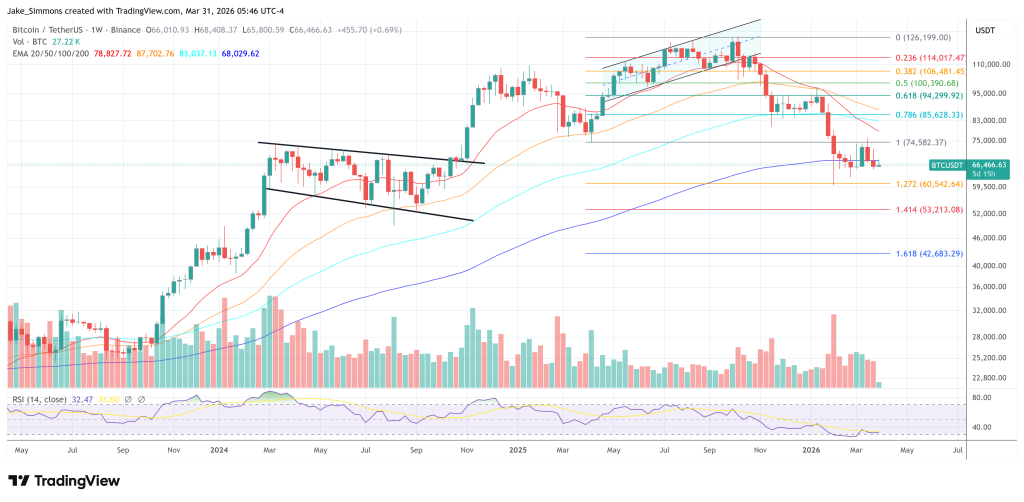
At press time, Bitcoin traded at $66,466.









 English (US) ·